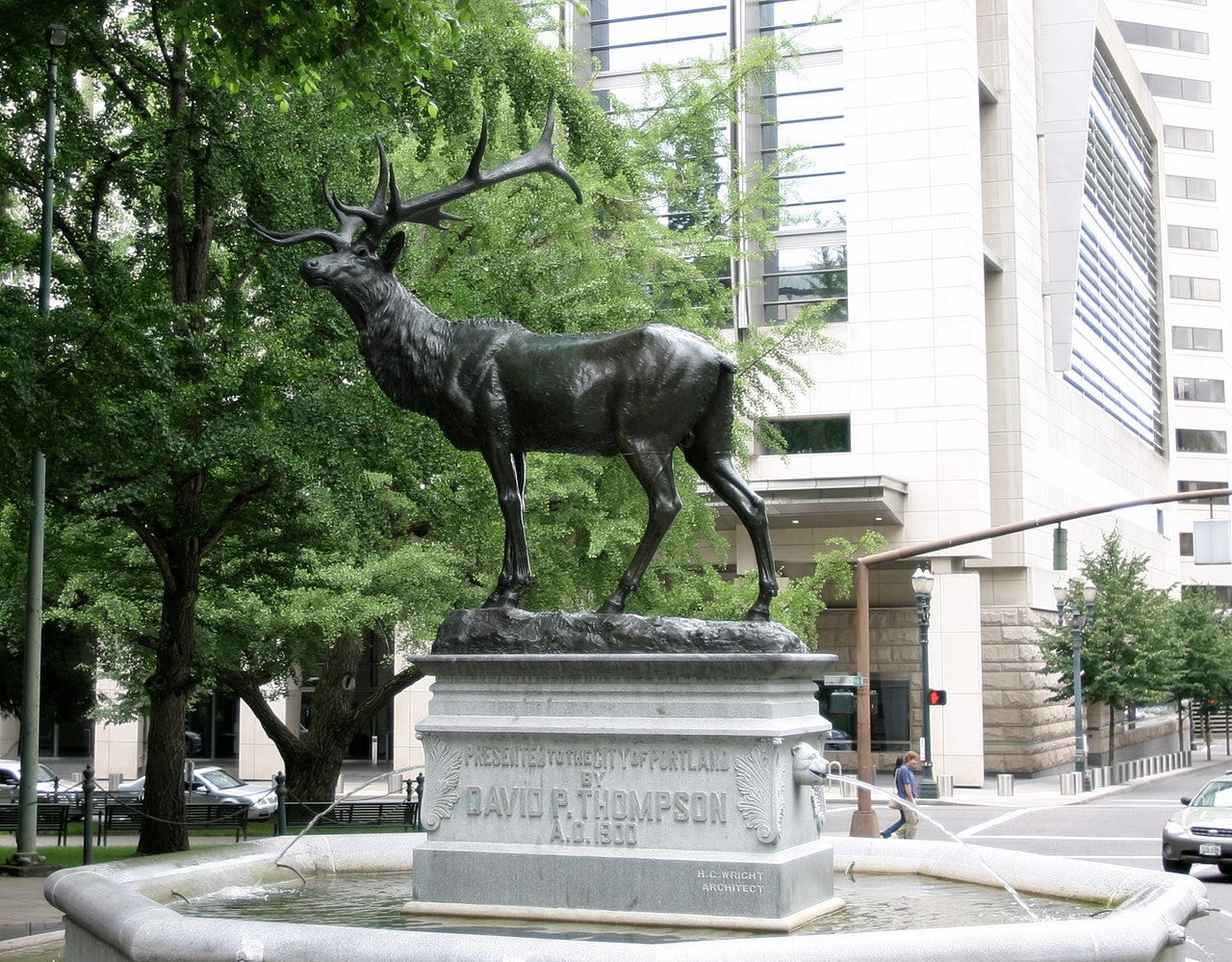
Oregon Public Broadcasting reports that 1.5 million dollars has been designated to replace the historic David P. Thompson elk statute downtown.
I remember growing up with the elk statue! It’s near the college campus where I lived with my Mom when I was small. I was also a witness to the destruction of the elk statue over the past three years. Protestors really did some crazy stuff to mess up that elk, let me tell you.
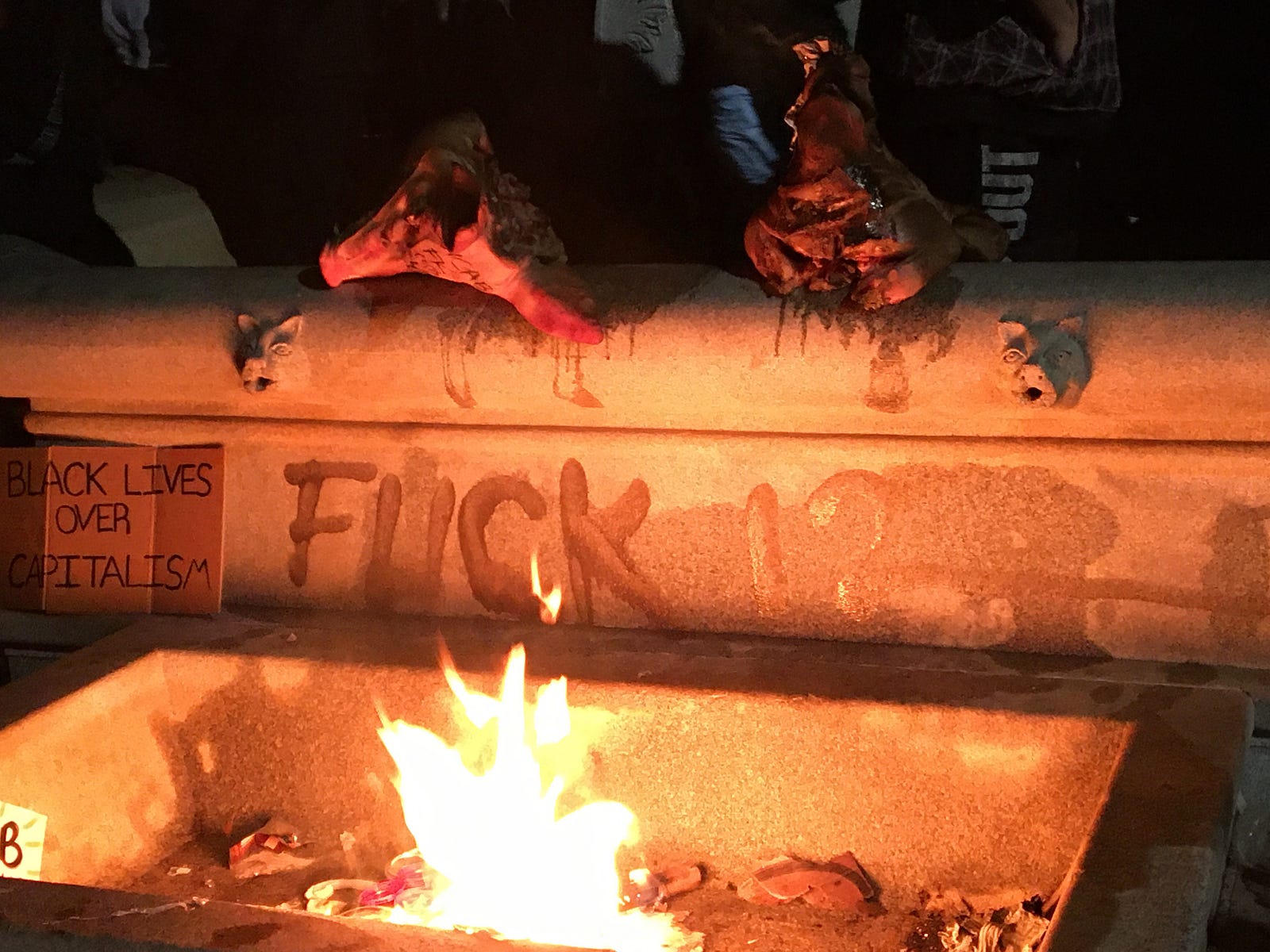
Here’s a photograph I took at a protest in May 2020: in this photo protestors are roasting pig’s heads over an open fire that they lit on the stone base of the statue.
Photo courtesy of author
Do we need a new elk?
While I loved the elk statue, and it made me sad to see it get totally destroyed, I understood the anger of the people who were doing it, and why they felt that destroying a piece of property might be an acceptable way to express that anger.
Personally, I’m not really big on the “tear down statues” method of protesting. I get why it happens, but something like an elk (it’s an animal, dude) seems pretty benign to me. The elk was pretty to look at, and I’m pretty sure that the local elk population isn’t guilty of anything bad.
It didn’t seem fair to me that the elk face the wrath of the protestor’s anger when it wasn’t really the elk’s fault or the fault of the artist who made the elk.
I’m not opposed to replacing the elk. I kind of miss it. But one million dollars seems like a lot of money for an elk statue. Money that could be going to say, things like helping the homeless get off the street or deal with their drug addictions and mental illness.
Or maybe the money could go to pushing for the kind of criminal justice reform which is needed in order to prevent the kind of misplaced rage in the populace which caused the destruction of the elk in the first place.
Remember the tram?
The one point five million approved for the elk reminds me of when the OHSU aerial tram was built in Portland. Essentially, the tram is a giant and terrifying way for the local hospital to give people more access to parking.
The tram cost A LOT of money, and it didn’t really have the full support of the community. It was marketed as something that would It was marketed as something that would look good as a part of the Portland skyline. But not everyone was into it.
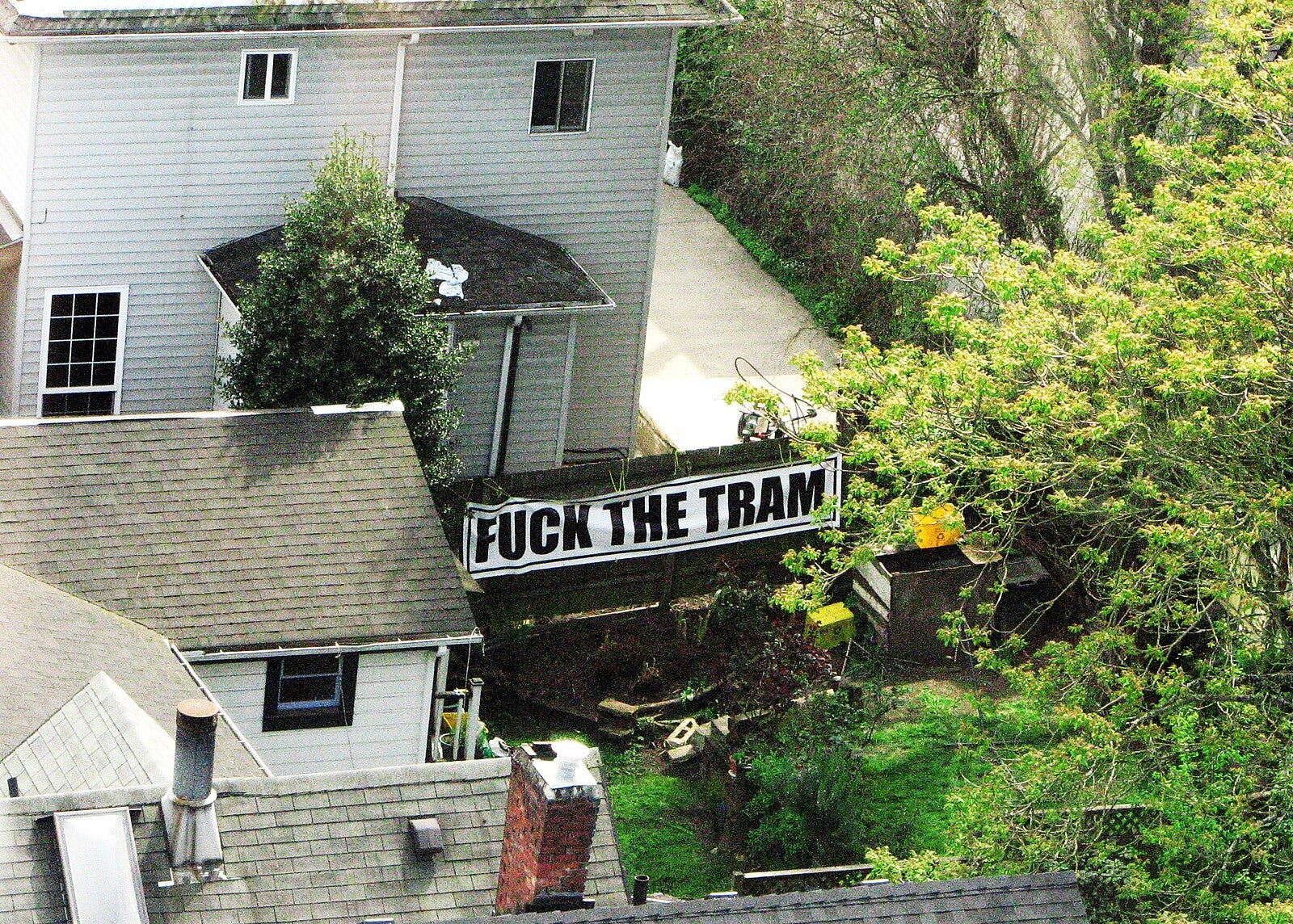
People who live underneath the tram even went as far as to put up a sign that said “Fuck the Tram.” They felt that it encroached upon their privacy and other rights.
As OPB reports, ten years after the tram’s construction, the tram costs millions of dollars, much of which came straight out of the pockets of local taxpayers. It was controversial at the time of its construction and remains so today.
“Accusations of mismanagement and subterfuge flew,” writes OPB’s Randy Gragg of the funds used to build the tram. The people who designed and built the tram ended up going way over budget. Gragg also notes that the affordable housing in the south Waterfront neighborhood went unfinished as the tram was finished.
Is the new elk statute another expensive and ridiculous boondoggle put in place by the leaders of the city of Portland to make it seem like everything is going well when it isn’t?
Wouldn’t the money be better spent feeding the homeless?
Why is it so easy sometimes, and so difficult other times?
There are lots of reasons for this, but sometimes it helps to simplify things a bit. When we make the decision to create something wholly for our own satisfaction and benefit, it can be a great cure for creative block, mostly just because it allows us to be ourselves with a little bit more comfort and ease.
Shaking off the fears of failure and judgment
When you make a piece of art just for yourself, the pressure to impress, please, or touch others is off. You don’t have to worry about who will like it, how it will be received, whether or not you can sell it, or if anyone will truly understand what you were trying to say. Taking this kind of pressure off of ourselves gives us more freedom to express ourselves honestly.
Be honest — when you put pen to paper (or whatever your equivalent is) don’t you hesitate sometimes, thinking about who will read what you’re about to write? I hate to think of the many great ideas that have been lost to the world because of an artist’s brief moment of doubt.
Artists are often perfectionists, and it’s easy to want to toss out a whole idea because it’s not up to our own standards, or to the standards by which we believe we will be judged. Throwing away the measuring stick is one of the best ways to encourage growth.
It’s a shame for anyone to have to be boxed in by the expectations of others, or discouraged by fear and the possibility of failure or embarrassment. We have to be free to create dangerously without limits. The best, most unique ideas come from thinking outside of the box, and it’s easy to be comfortable doing that when the potential consequences are less of an issue.
Art is about communication…
When we make a piece of art and show it to someone else, we are allowing that person to see the world from our point of view for a brief moment. One of the reasons why art is so necessary is that it helps us to feel less alone in a world that is sometimes scary and confusing.
Art is a means of communication that is often superior in many ways to more direct ones, despite often being far more ambiguous. When we make art, we can’t guarantee that others will understand what we are trying to say or feel the way we felt. Still, we’ve all experienced it– when you do feel that connection to another person’s art, it’s pretty hard to ignore.
…not just with others, but also with yourself
While art can be a great tool to express to others what you’re thinking and feeling, it’s often just as important, if not more so, to express your thoughts and feelings to yourself. Our minds are complicated, and sometimes it’s hard to decipher what we truly think and feel.
Art can be a powerful tool for introspection and self-reflection because it allows us to see the things that we are hiding from ourselves. Like our dreams, art tends to reveal recurring themes from our subconscious mind, which can otherwise be difficult to access with our conscious efforts.
Sometimes we don’t truly understand our own thoughts, feelings, hopes, fears, or motivations until we turn our focus inward to try and understand ourselves better. While others can enjoy and connect to your art, it’s important that we also take this inward step. If you aren’t looking inward first, how can you be confident in what you’re expressing outwardly?
Understanding our own subconscious drives is a powerful tool for taking ownership of our conscious actions. This is important for happiness because life becomes more meaningful the more our actions line up with our true beliefs. We can’t change our own thoughts or behaviors until we understand why we are thinking and behaving the way that we do.
Making art doesn’t just make you a better artist, it makes you a better person.
Learning to love the process
When I create art for myself, it reminds me that the true joy in art is in the creation of it, not in the final results. This is true about most things in life– you’ll be happier if you focus on the journey instead of the destination.
When you create just for the sake of creating, you remember that creating itself is the point. Creation is not just a means to an end but, also an end in itself. This is a very easy thing to forget.
Loving the process also improves our process. Often we can get hung up on a false dichotomy: quality vs quantity. The truth is that we can’t help but get better at the things we do frequently, and that quantity will eventually lead to quality, as long as we persevere. For every hundred scribbles we make on our own time, maybe we’ll find one that we want to share with the rest of the world– if we’re lucky. This might seem daunting, but really, it’s a good thing.
When we give our full attention and a healthy mindset to our practice, it becomes deliberate, helping us learn, improve, and dependably moving us closer to our goals. This kind of practice might not make us perfect, but it will make us just a little bit better than we were yesterday. The process is where we learn where our strengths and weaknesses are, what we like and dislike doing, and what feels meaningful to us.
No act of creation is ever a waste of time.
Brain benefits
In addition to getting your creative juices flowing, making art (even if it’s just for you) has a lot of other practical benefits.
Creating art forges new neural pathways in the brain, allowing us to think more creatively at a tangible, physical level. This helps us to respond to the world in a way that is more intelligent and integrative, building connections between our logic, emotions, and imagination. Making art is also a proven method for treating substance abuse, and can help us heal from trauma.
It doesn’t even take a very big time investment to start seeing benefits. A 2016 study showed that just 45 minutes of making art is enough to improve your feelings of self-confidence. But you don’t need a study to tell you that– you’ve probably experienced it.
All of this in less than an hour.
All of this without rules, deadlines, or criticism.
All of this without worrying about likes, claps, or upvotes.
All of this from the safety and comfort of your own home.
You don’t even have to put pants on!
Originally published on medium.com on December 19th, 2019.
Everyone’s creative process is different, but I’ve noticed a real trend among artists of ebbs and flows in inspiration and productivity.
An artistic temperament has often been associated with ups and downs in mood, which is unsurprising considering there seems to be a much-discussedrelationship between creativity and mood disorders.
First, I think it’s important to make the distinction between illness and genius. Note that, at extremes, both positive and negative mood swings can actually impede creativity. There’s a problematic image of the “mad” artist in popular culture which I think often, unfortunately, becomes a self-fulfilling prophecy, but that’s not what I’m here to write about today.
Not all artists have mental illnesses; nonetheless, many creative people report experiencing something akin to mood swings when describing their creative process. The positive, functional moods which could be described as “strokes of inspiration” are something well-documented in the artistic world, and also increasingly in the realms of psychology and neuroscience.
You might have heard this referred to as a flow state, or “being in the zone”. Whatever you call it, I don’t think anyone experiences it all the time, and it’s always something to be grateful for when it comes around.
Since I’m a romantic sort of person who loves mythology and archetypes, I like to think of these moments in my creative life as “visits from my muse.” It helps me understand my own process better to personify the unknowable force which allows me to bring something forth from the nothingness that once was.
I’ve read a lot of articles about the psychology and neuroscience of creativity and productivity. I’ve read lots of guides detailing the logical steps you should take in order to optimize your ability to get into and maintain this sort of state.
While I think it’s helpful to understand things like this from a rational, materialistic, perspective– I think it can be a big leap bringing this comprehension from the conscious mind back into the unconscious programming which will drive our actual behavior.
In situations like this, I like to take a mystical perspective instead.
I like to imagine my muse as a temperamental diva who shows up either when the mood strikes her or when she believes I’m ready to hear what she has to say. Like most powerful and enigmatic women, my muse is complicated, and she isn’t easily wooed.
If your muse is anything like mine, it might be helpful to keep a few things in mind during your love affair.
Understand what attracts her
No self-respecting woman would be attracted to someone who doesn’t take care of themselves, and my muse is no exception. If I’m really screwing up when it comes to eating healthy, exercising, getting enough sleep, or any of the other basic responsibilities that I have to my beloved meat-suit, I’m a lot less likely to be able to get her to call me back.
Letting yourself go when it comes to caring for your physical, mental, or emotional health will certainly turn the daughters of Zeus all the way the off. I mean, who can blame them? No one wants to go out dancing with a lazy couch potato who can’t bother to shower and change out of those sweats and into a pair of dancing shoes.
Don’t be your muse’s Tinder left-swipe.
Also– don’t you think a gorgeous, intelligent goddess like your muse would want to hang out with somebody interesting?
My muse is happy to meet up for coffee and chat about that new book I just read or that interesting podcast I just listened to, but she isn’t really that impressed by the shallow gossip I heard or the hours of Netflix I binge-watched last week.
It’s not all about appearances– muses are attracted to people of substance.
Give her your full attention when she arrives
The thing about the muse is, you never really know how long she’s going to stay when she shows up. Muses can be fickle like that– they’re kind of afraid of commitment, so often you have to settle for a no-strings fling.
Make the most of it! When a woman like her steps into your world, you make the time to spend with her, if you know what’s good for you.
Practice active listening when you’re interacting with your muse. Really look her in the eyes. Repeat back what she says. Shut the hell up for a little while and stop talking about you.
And take notes!
Sometimes the muse will show up bearing all sorts of ideas, and no matter how much time you carve out of your busy schedule to accommodate her, it still won’t be enough. Write down the good ideas for later if you can’t get to work right this minute.
But don’t be too clingy
You can bring her flowers– but don’t be a stalker. Don’t try to force things, that will only make the situation awkward. You know what I’m talking about. If you’ve been calling her and she’s not picking up, cool off for a bit.
“When inspiration does not come, I go for a walk, go to the movie, talk to a friend, let go… The muse is bound to return again, especially if I turn my back! “ — Judy Collins
Show her you’re worth it
If you’re trying to show a fine woman that you’re worth her time, actions speak louder than words.
Be honest with your muse about the responsibilities you’re capable of taking on and the reasons why you want to take them on in the first place.
Hera didn’t raise any fools, and you’ll definitely regret trying to do this girl dirty. Muses can see right through your bullshit, and they know if you’re just blowing smoke when you say you’re ready to get serious. Like most relationships, you get what you give in your relationship with your muse.
Show up for her when it matters. She wants to know she can depend on you. You have to make her feel safe. Work on building trust with your muse.
“I show up in my writing room at approximately 10 A.M. every morning without fail. Sometimes my muse sees fit to join me there and sometimes she doesn’t, but she always knows where I’ll be. She doesn’t need to go hunting in the taverns or on the beach or drag the boulevard looking for me.” — Tom Robbins
Understand that she’s worth it
If you‘re hanging around a’ good woman and she realizes you don’t value her, she’ll be out the door before you can say “Melpomene.”
Having a muse by your side will make all the difference when it comes to fighting the battles of your creative process. She can teach you things about yourself and the world that you never imagined were possible, and make you feel things that you didn’t know you could feel, but don’t expect her to stick around if you don’t appreciate her.
When your muse gives you a good idea, don’t take it for granted. Show her that you’re actually paying attention to the words she whispers in your ear, and maybe next time she’ll sing you a song.
Originally published on medium.com on October 24, 2019.



 Esoteric Epistemology