Just How Smart Are Octopuses?

Are claims of “octopus civilization” credible? 
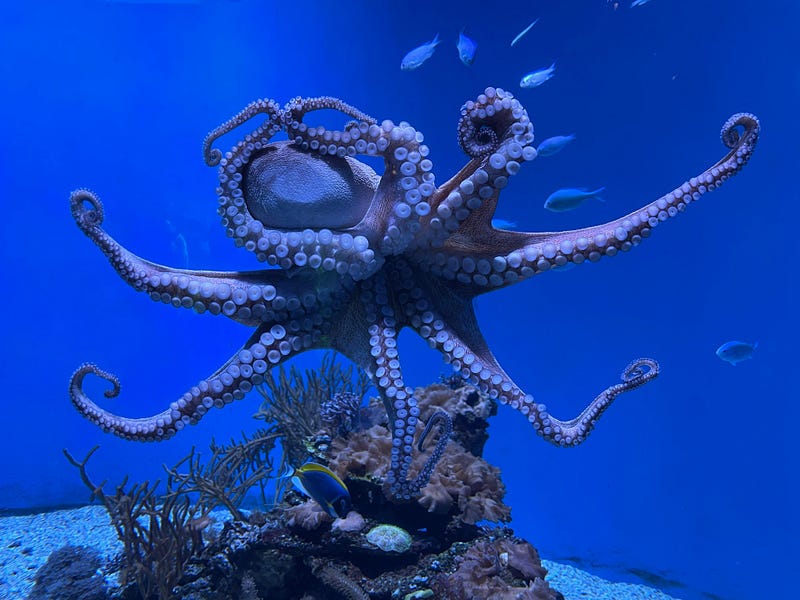
Octopuses are undeniably fascinating creatures. Possessing superpowers that human beings can only dream of, they have the ability to regrow limbs, “taste” with their arms, and change their appearance at will. These fascinating skills are just a small part of why octopuses are of interest to science and to anyone who is curious about the natural world. 

I’ve always thought octopuses were pretty neat, but I became way more became more interested in our eight-legged buddies after I read The Soul of an Octopus by Sy Montgomery and after I saw the Netflix documentary My Octopus Teacher. These pieces of media were made by people who got up close and personal with octopuses and really got to know what they were like, kind of like Jane Goodall studying chimps, but underwater. 

Speaking of chimps, I’ve also been reading about Nim Chimpsky, a chimp who was taught sign language and other human-like behaviors by a team of researchers. Nim became so human-like that he would even smoke and ask for marijuana. While the ethics of smoking weed with a chimp are dubious, the reality of Nim’s life and the lives of other animals like him will forever fascinate science. 

After reading the work of biologists and animal behaviorists, I’ve become really interested in animal intelligence. Well-known for being some of the smartest and most unique creatures on the planet, octopuses keep popping up everywhere I look.

Octopuses have been spotted using tools, including carrying coconut shells for shelter. They are also well known for their ability to solve puzzles, often escaping their enclosures. They’ve figured out how to do things like open jars or the lids of fish tanks for example, in order to get food or in a bid for freedom. It’s no wonder that we find octopuses endlessly entertaining.

Octopus Obsession

Octopus-themed media seems more common these days. Like most animals when studied up close, it’s difficult to avoid anthropomorphizing octopuses. Also like most animals, octopuses have personalities. It seems like they have individual tastes and preferences, relationships, and the ability to problem-solve: in other words, everything that makes up a mind. But how similar to a human mind is a cephalopod’s mind, really? How much of my own ideas about what a mind is am I projecting onto the octopus? 

There’s uncomfortable questions that I always ask myself when I think about animal intelligence. What would we do if we discovered that they were as smart as people? Would that mean that they deserved rights? To be treated as a foreign nation rather than as a research project, a science experiment or a meal? 

Part of why octopuses are so spellbinding is because of how alien they are in both appearance and demeanor. What if we encountered a species of aliens that were as different from us in appearance as octopuses, and as intelligent as people? Would we be able to accept them as intelligent? Or would we treat them the way we treat animals on earth– as living beings that are “below” humans in a moral way, and undeserving of the same rights?

Octlantis and Octopolis: Octopus Cities? 

I was startled when I first read about alleged “octopus civilization” online. I saw some clickbait-y stuff about it popping up in my Facebook feed and decided to look for more information to find out how credible the claim was. 

I was stunned to immediately find a Wikipedia page that describes clusters of octopus dens as “non-human settlements.” Wikipedia was quick to clarify that despite being called “Octlantis” and “Octopolis,” that referring to these sites as “cities” is something that researchers might find to be “misleading.” Still, “non-human-settlements”? With my curiosity about octopuses, I was hooked. I knew I had to investigate further.

Researchers Martin Hing and Peter Godfrey-Smith published a piece in The Conversation in which they discussed to what degree the octopus “cities” they studied were “intentional” on the part of the octopuses. Hing and Godfrey-Smith were part of scholarly research into the matter, in which they stated that “city” is is not an accurate description of the sites they observed, contrary to the bold claims made by The Guardian, Science, and Discover, for example. 

“In a series of news reports written about our paper, a tendency has grown to exaggerate what we reported,”

say Hing and Godfrey-Smith in a subsequent paper. 

The media is often quick to sensationalize stories like this, while real scientists maintain their skepticism. I do think it’s reasonable for these researchers to try and clear up any confusion and to urge people to temper their expectations when it comes to such claims. Still, I’m not totally convinced by the debunking done by Hing and Godfrey-Smith. To me, it doesn’t seem that far-fetched that a non-human species could do something like build a city. Octopuses don’t seem like an unlikely candidate. 

I kept reading and I found that other researchers, like Jennifer Mather, are also making a case for octopus consciousness. 

“…the capacity not just to acquire information and store it across time but to guide information extraction when the octopus is producing motor play goes beyond a cognitive foundation, perhaps to consciousness,”

writes Mather. 

Others, like Piero Amodio, think it’s better to remain “agnostic” about the topic. Still, Amodio speculates:

“Future research may eventually support Mather’s view that octopuses are capable of future planning and causal reasoning.”

 It seems to me that the debate about octopus intelligence is far from over.

Octopus Abuse 

Thinking about how intelligent octopuses are makes it really uncomfortable to accept how they are treated by humans.

I used to find it upsetting that people in some countries eat octopuses while they are still alive– it seemed cruel to me compared to killing any animal prior to eating it. Still, in the wild, an octopus might get eaten. Eating another living creature or being eaten isn’t a foreign concept to an octopus. What humans do to octopuses for medical research is far more cruel (in my opinion) than what happens in nature.

For example, researchers studying limb regeneration routinely cut the tentacles off of octopuses in order to observe them growing back. While Smithsonian Magazine insists that something like this is “no sweat for the cephalopod,” to me, this seems like animal cruelty, something that should probably be illegal. 

Research suggests that octopuses feel pain. Spending your whole life tied up and having your arms or legs cut off over and over again sounds way worse than being eaten, even if they grow back! At least if you are eaten, it’s over relatively quickly. Imagine if aliens kidnapped you and pulled out your fingernails and toenails or teeth to study their regrowth. Imagine if they did that to your family members. Would you be upset? I would. 

Now imagine if someone dumped a bunch of trash in your neighborhood. Can you see where I’m going with this? Should we be treating such intelligent creatures, who are capable of so many incredible things, with such callus cruelty? Is it something we will come to regret as a species in the future?

What if we’re wrong? 

Sometimes I think about the deep ocean, and how little we actually know about what’s really down there. Beyond a certain depth, human beings and most of our scientific instruments would be crushed by the pressure of the ocean water, limiting our investigations of its mysterious depths.

What if researchers are wrong about octopus “cities” being the stuff of overzealous clickbait? What if we aren’t taking them seriously enough? I think that when researches reduce animal behavior to things like “looking or food” or “attempting to attract a mate,” they often forget that that these things are also what comprise much of human behavior. Maybe we just don’t understand their culture. 

Also, octopuses aren’t the only water-dwelling creatures who show signs of intelligence. Dolphins have been shown to recognize themselves in mirrors and pufferfish create beautiful sand mandalas to dazzle their mates, for instance. How many creatures are living at depths that humans can’t travel to? What are they like? How smart are they?

If I were an intelligent water-dwelling creature and knew that I could avoid humans by staying in the deep ocean, I probably would. After all, humans are known for treating non-human creatures horribly. We’ve done it throughout most of human history. Like octopus researcher Peter Godfrey-Smith, I think that if there’s a species in the deep ocean that’s as smart as us, interacting with them would almost be like interacting with an alien civilization. Just like with space, if anyone is out there (or under there), they might just be smart enough to steer clear of human beings. 

I’ll never stop imagining the massive krakens that could be living in the deep ocean, or worrying about whether or not they are smart enough to understand what humans are doing to their habitat and relatives. While claims of non-human underwater civilizations are unsubstantiated thus far, I’m keeping an open mind.
Elephant Epistemology

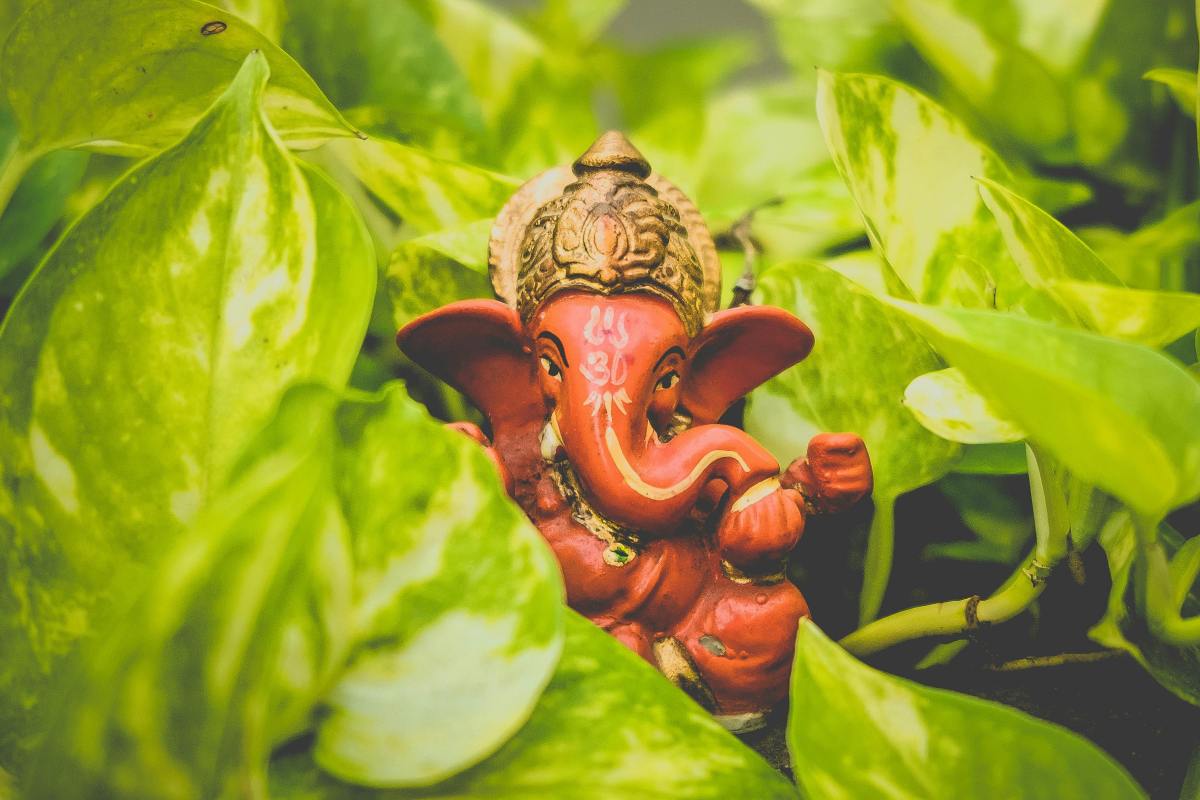
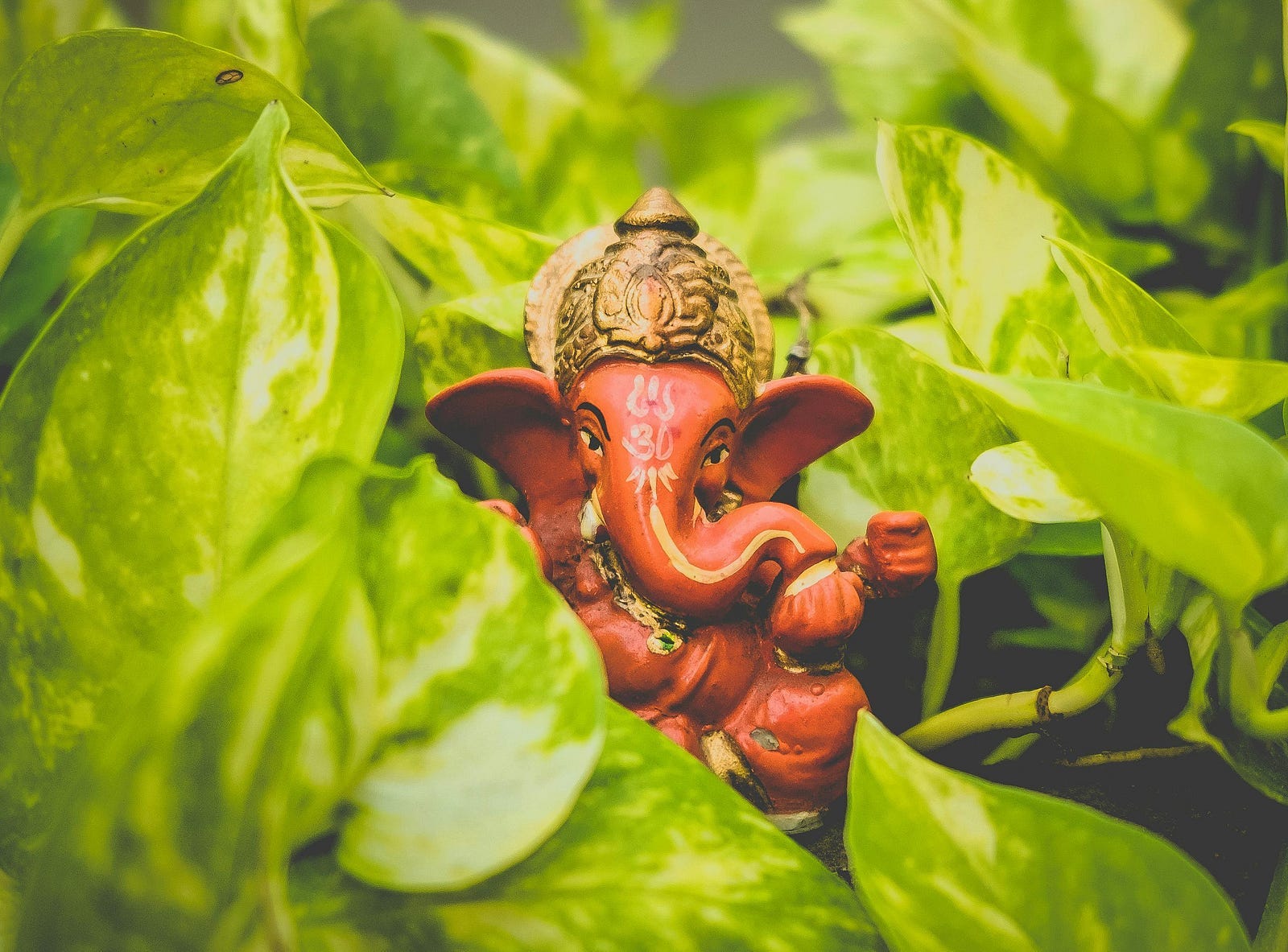
Ceramic sculpture of Lord Ganesha hiding among the shrubbery.

How perspectivism can make you a better thinker 

Storytelling is one of my favorite ways to communicate ideas. I remember stories more easily than I remember boring lectures.

Have you ever heard the story of the blind men and elephant?

The story goes like this: several blind men approach an elephant. The first man grabs the elephant’s trunk and thinks that it is a rope. The second touches the elephant’s leg and thinks it is a tree. A third blind man touches the elephant’s ear and thinks it is a blanket.

The story goes on like this. Each of the blind men has a piece of the truth, but none of them can see the whole elephant.

My elementary school librarian introduced me and my classmates to this story as a child in the form of the children’s book Seven Blind Mice by Ed Young. In the book, the role of the blind men is played by mice. I remember thinking about it a lot as a child.

I’ve heard several different versions of the story since then. I discovered through research that the story has its origins in the folk mythology of the ancient East. It was popularized in the West by John Godfrey Saxe, who called it “A Hindoo Fable.

The story is currently used by the Peace Corps to teach about cultural differences. It’s also a great story for teaching perspectivism.

What is epistemology?

Most Americans barely (if at all) even know what epistemology is, but it affects each of us in our daily lives in countless ways. For those who don’t know, epistemology is the branch of academic philosophy which deals with knowledge production.

Epistemology is what helps us distinguish the ideas we consider to be factual and true from the ideas that we consider to be subjective opinions. It helps us establish the “Overton Window,” the socially acceptable boundaries of the arena of public discourse.

Nietzsche and Eastern Philosophy

When I was going to college for philosophy and doing research on Friedrich Nietzsche, I found lots of evidence that his epistemology and ethics were influenced by Eastern thought.

I first read Thus Spoke Zarathustra when I was about twenty-two, and I found the spirit of the book to be too similar to stories from Hinduism and Buddhism to ignore. The protagonist of this book is named after Zoroaster, an Iranian prophet similar in character to many of the Buddhist Bodhisattvas.

In the story, Zarathustra speaks to a dwarf who I recognized as resembling Vamana, an incarnation of Vishnu, who is the preserver and balancer of the universe in Hindu mythology. Vamana made sense to me as the deliverer of information about eternal recurrence in Nietzsche’s mind, as Vishnu is the upholder of moral order and associated with time.

Another avatar of Vishnu, Krishna, declares himself in the Bhagavad Gita:

“I am mighty Time, the source of destruction that comes forth to annihilate the worlds.”  

Like the god Shiva, who is better known for being the the “destroyer” of the Hindu canon, Vishnu is often depicted with snakes, or nagas in Sanksrit. Shiva is usually depicted as holding a snake named Vasuki wrapped around his neck while Vishnu is often depicted as reclining on a snake named Shesha. Shesha represents the fabric of space and time in Hindu metaphysics. 

Snakes are associated with the eternal cycle of death and rebirth in Hinduism, and also in Western culture in the form of the Ouroboros symbol, the snake eating its own tail. I believe this mythology was part of the inspiration for Nietzsche’s eternal recurrence.

Perspectivist Epistemology 

When I was in my late twenties, I started doing further research about Nietzsche and Eastern philosophy, and I began to seriously consider the elephant story again.

Part of what separates Eastern perspectivism from Western Kantian epistemology is the idea that the noumenal world (the “real” world that is never fully knowable to us through empirical observation as the blind men in the elephant story) is at least partially knowable through introspection, like the kind encouraged by Eastern meditation practices. 

Arthur Schopenhauer, one of Nietzsche’s influences, made a similar argument.

I found that this story, while helping me to explain Nietzsche’s perspectivism, also provided an eloquent introduction to Eastern views on epistemology more generally. 

Western philosophy is more likely to tell you to look outside yourself for an answer to a philosophical question, while Eastern philosophy is more likely to tell you to look within yourself. While this might seem self-centered on the surface, in practice, it actually leads to greater empathy and understanding of opposing perspectives. 

When I looked at both Eastern Philosophy and Nietzsche’s ethics, I found mostly Virtue Ethics, which are basically just theories about how to be a good person. Virtue Ethics is also a theme throughout many stories about Eastern sages: they tend to be tales about the many different ways that there are to be a good person.

You can’t have ethics without epistemology, as it determines where you get and how you interpret the information on which you base your values. You can’t have epistemology without ethics, because your values inevitably guide your knowledge-seeking. I think that virtue ethics naturally follow from a perspectivist epistemology. 

Eastern Philosophy and Nazis

For Nietzsche, a misinterpretation of his perspectivist epistemology resulted in his ethics being misappropriated and warped by Nazis.

Nazis learned about Eastern philosophy from Nietzsche and from a Hindu woman named Savitri Devi. They used Nietzsche’s work as a vehicle to misappropriate and warp the principles of Eastern philosophy that Nietzsche admired. Some of these stolen ideas became part of Nazi philosophy and culture.

This was some of the most effective political propaganda ever created. Centuries earlier, European Colonialists used the same kind of ideological misinterpretations to exploit the Hindu caste system. Both this and the Nazi misinterpretations of Hindu ethics influence modern Hindu nationalism and Nazi occultism.

I think that the Nazis wanted to appropriate and smear Hinduism because Eastern asceticism, like fascism, preaches a disciplined lifestyle. The difference is that Hindu ascetic discipline comes from within, while fascist discipline is forced on a population by corrupt authority figures.

The Nazi misinterpretation of Hinduism is fundamentally a misinterpretation of what it means to be powerful. Nazis preached the power of the boot and the fist while Hinduism preaches the power of self-discipline and fearless compassion.

Smearing a symbol

Probably the most commonly known example of this philosophy mistake is the story of the swastika symbol. The symbol adopted by the National Socialist Party in 1918 originated as a Hindu symbol for peace. There are also many similar-looking symbols in other cultures.

The swastika is sometimes thought to be originally based on the swirling shape of galaxies in the cosmos, or on the shape of the movements of the sun in the sky. Because of the Nazi smear-job, the symbol seems to be permanently associated in the public consciousness with Adolf Hitler and the atrocities of the Nazi regime.

So why is epistemology important?

Mistakes like this are common throughout history in both philosophy and science, and they serve as ridiculous and terrifying examples of why the disciplines of philosophy and science need each other and always will.

Epistemology is a critical intersection of philosophy and science, because it’s the part of philosophy that convinces us that we should trust science in the first place, and whose science, and why. It’s also a critical intersection of philosophy and politics because it tells us which politicians we should trust and listen to, and when, and why.

When the consequences of a philosophy mistake are the facilitation of the literal Holocaust, it makes sense to pay attention to how that mistake was made and how to avoid that mistake and other mistakes like it in the future.

That’s what I’m aiming to do by telling you this story.

A horrible epistemology mistake led to the peaceful, compassionate philosophies of the East being misinterpreted by Westerners (and some Easterners) as the building blocks of literal fascism.

I want to show you how to avoid making the same kind of fatal mistakes in your own thinking, and how to correct them when they happen.

Elephant Epistemology

Another thing about elephants: it is said that they have excellent memories. It is said that they “never forget.” I’ve never forgotten the lesson of the elephant story.

Now, every time I think about my own epistemology, I start by thinking about the elephant. Since my perspective as a single human being is limited, I can only perceive one part of the elephant at a given moment.

When I begin pondering how much I know about something and why I know it, I keep in mind that the other perspectives on whatever I’m pondering are probably different. That doesn’t mean that what I’m seeing is right and what others are seeing is wrong or vice versa, just that I have to keep an open mind to the parts of the elephant that I can’t see.

The thing about life is this: just when you think you have it figured out, there’s always more to the story.

How to use Elephant Epistemology

By talking about the history and practice of epistemology in a more casual and less academic format, I’m hoping to get people interested in a way of seeing the world that will broaden their perspective and empower their ethics and decision-making.

The sad truth is that people mostly think about their own perspective and the perspective of those like them in most situations. That’s not the best way to get an accurate picture of what the world looks like.

The best way to do epistemology like an ancient Eastern sage is to gather your knowledge from a variety of viewpoints and to try to think from the perspective of each of those viewpoints.

It’s the old story of putting yourself in someone else’s shoes. The other person might be living, dead, or not even a person at all. Try thinking from the perspective of a plant or animal, for instance (maybe an elephant?). Then you’ll start to get a feel for the kind of epistemology that I think is effective for producing good knowledge.

Remember that, like the men in the story, your own perspective is always going to be limited to whatever part of the elephant is near to you. No one is omniscient (not even God, in my opinion), and learning is best approached with as much humility as you can muster.

A word from Lord Ganesha

In the ancient Hindu epic Mahabharata, the Hindu god Ganesh is creatively credited as the one who wrote down the tale as dictated to him by the Hindu sage Vyāsa.

The elephant-headed god Ganesh is depicted in the story as having written down the story with one of his tusks, which he removed and dipped in ink after the feather pen he was using broke during the dictation. This story highlights the importance of the elephant in Hindu culture as a symbol of the processes used to obtain knowledge and wisdom.

Ganesh is seen in the Hindu faith as the placer and remover of obstacles.

An important lesson from this story about Ganesh: when you are searching for the truth, you will always encounter obstacles. What’s really important is your ability to overcome these obstacles and adapt your thinking to your changing perspective on a changing world.

Keep the elephants of Hindu mythology in mind as you embark on your journey to find the truth.