Why Dogs Are Good for You

Having a pet made me care about myself more

two people and a dog walking on a beach on grey sky day
Photo by Emma Dau

I’ve had my dog for nearly six years. I’ve had her since she was a puppy, taking her home after I helped care for her unbearably adorable litter of nine. She’s a healthy and energetic mutt, who loves people, fetch, and a good chew on a bone. She’s lived with me in three different states and traveled with me on many adventures.

Dogs are “man’s best friend” for a reason. We’ve co-evolved with canines for about 14,000 years. Our two species have a long history of helping and influencing each other. My dog and have a very symbiotic relationship. She does quite a lot for me in exchange for head scratches and kibbles.

My life is better because I have a dog. Not just because she’s cute, fun to be around, and nice to cuddle with; but because taking responsibility for another sentient being has increased my sense of responsibility for myself.

You have to take care of your dog (and you)

Dogs need food, water, exercise, bathroom breaks, entertainment, and affection. Humans need all of these things as well, but for some reason, it’s sometimes easier for me to remember that my dog needs these things than it is to remember that I do.

I’m not just concerned with keeping a roof over my own head, but also my dog’s head. I chose to live near a beautiful park, so I could walk my dog there. My dog needs to have a routine, so I must also have a routine. Every time I feed my dog, I’m reminded that I also need to eat. Every time I pet her, I’m reminded that I also deserve love and affection.

I imagine that this is a similar sense of responsibility that I would feel if I had children, but perhaps without so much pressure to be a good parent. It’s pretty simple to be a good parent to a dog — feed her, walk her, take her to the vet once in a while, and rest assured that she’s probably not going to resent you when she grows up.

Dogs make you do stuff

I have to get out of bed in the morning whether I like it or not because my dog needs to go for a walk. When I’m feeling like wasting the day in bed … too bad. My dog definitely won’t stand for any of that nonsense. It’s get up, or face the horrors of the face-licking alarm clock.

As most people who have struggled with their mental health could tell you, getting out of bed can sometimes be a challenging thing to do if you’re not feeling your best. Having a dog makes it so I have no excuse, and walking her is a dose of exercise and sunlight that is built into my day.

I also sometimes meet people because of my dog, like when I ask someone at the dog park if their dog is friendly, or when my dog bumps noses with someone else’s at the pet store.

Dogs are a social lubricant — kind of like alcohol, but less damaging to the liver. It makes sense that dogs have been shown to be a conduit for getting to know people, friendship formation, and social support.

My dog also makes me want to get out into nature more. Anyone who has seen a dog sniff around in the forest knows how joyous it is. Because of my dog, I end up hiking more, which has both positive physical and mental benefits.

Dogs are good for your brain

Dog owners know from personal experience that our four-legged friends make us feel happier, but this idea is supported by science as well. Aside from encouraging you to get exercise, which is good for both physical and mental health, dogs have other positive effects on our minds.

Recently, researchers at Washington State University found that dog exposure lowered levels of the stress hormone cortisol in students. Playing with a dog can also help raise levels of serotonin and dopamine, which make you feel calm and happy.

In a 2009 study, companion dogs were shown to help seniors in a long-term care facility with anxiety and depression. Dogs have also been shown to help kids with ADD manage their symptoms.

I think dogs are good for mental health because they love unconditionally. Generally, if you’re nice to a dog, he will be nice to you. Dogs don’t care if you’re a hyperactive little kid or a grumpy old person. They don’t care how you dress, if you’re a good conversationalist, or if you’re a little weird at parties. They are very forgiving of mistakes, and they don’t hold grudges.

It’s clear: A dog is a powerful prescription for peace, and the worst side effect is that she might poop on your rug.

Having a pet isn’t for everyone, but if you’re feeling lost in life, or having a hard time finding the motivation to care for yourself, it might be something to consider.

I’m a better person because of my dog. This is because she creates accountability for me.

It’s not just my own quality of life that I have to be concerned with, it’s my dog’s as well. Taking on any kind of responsibility is usually a good strategy for feeling more confident and making your life feel more meaningful. My dog makes my life feel doubly meaningful because she’s a member of my family and a pure joy to be around.

There’s something about putting conscious love and attention into something living that is just plain good for you.

A goldfish might help, too. Hell, even a plant. But there’s nothing in this world like a dog.


Originally published on medium.com on January 21st, 2020. 

Your Choices Matter


Hard determinism is for defeatists

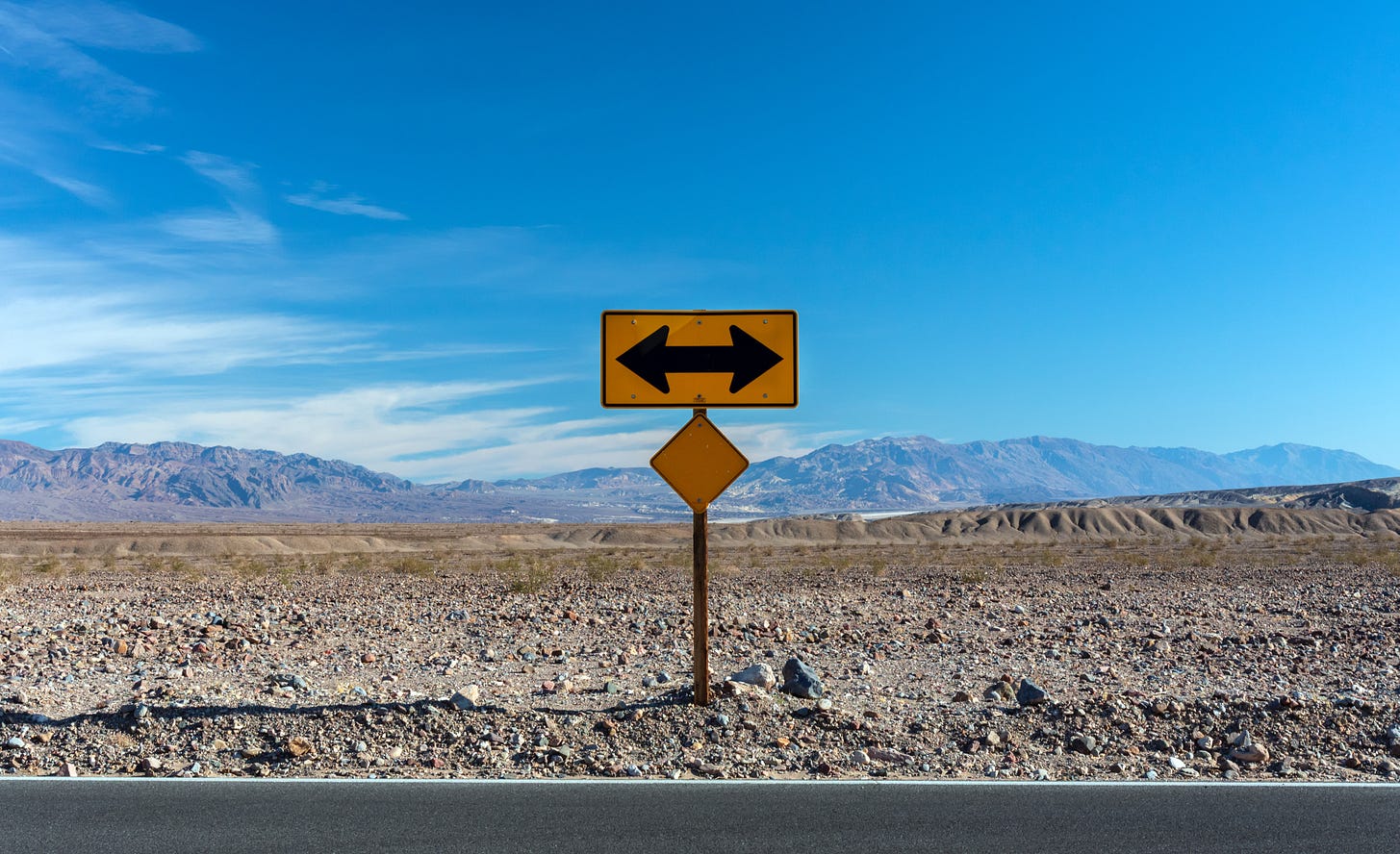
road sign with two arrows pointing to the left and right in the desert
Photo by Rosie Steggles

In philosophy’s problem of free will there are three major schools of thought. 

Determinism is the idea that there is no free will. Determinism says that everything that you and that everyone else does is predetermined and that there is pretty much nothing that you can do to change it. 

Free will says that you do have a say in your own choices and, probably, so does everyone else. 

Compatibilism is sort of in between free will and determinism. It’s the idea that some things are predetermined but that we have some degree of freedom. 

I’m a compatibilist. I believe that many things are beyond my control but that some things are within my control, and that the same is probably true for you. A person’s stance on free will says a lot about who they are as a person, because it can give you a clue as to what kind of reasons are driving the choices that they make. 

Why determinism sucks

It’s easy to fall into a deterministic mindset when it feels like things in your life or in the world are out of control. The problem that I have with hard determinism — or the very strong idea that all actions are predetermined, is that it encourages an attitude of passivity and helplessness in people. 

If you think that nothing you do matters, why do anything? Why care? Why try? Also, if we have no real control over the events around us or even over our own actions, how can anyone ever be held accountable for theirs? Is it just to punish someone for doing something bad or to reward someone for doing something good if they had little to no control over the act or over the outcome? 

We can’t know for sure 

The thing about free will and determinism is that it’s one of those problems that doesn’t really have an answer. It also doesn’t look like we are going to be coming up with an answer that has any kind of real certainty behind it any time soon. 

The free will problem as a philosophy problem is a fun thought experiment, but to solve it for real in the tangible, physical world in a way that you could depend on, you’d probably need an extremely brilliant physicist. Or, like, a team of them. 

So, if you can’t answer a question like this, why would you try to answer it anyway? 

I’d rather be free

My thinking on the problem is this: since I don’t know if I have freedom or not, it’s best for me to act as if I do. 

Why? 

Because if I feel powerless and trapped by the unending procession of time, I will be less motivated to do stuff. Also, if I am, in fact, responsible for my actions– or even if I’m not, I might face consequences for them. If I do have a choice, my actions are more meaningful, for better, or for worse. 

If I really knew for sure that nothing I did really mattered, I would probably do some pretty crazy stuff. But if that meant that hard determinism was true, then wouldn’t I have done the crazy stuff anyway, regardless of whether or not I wanted to or honestly attempted to? 

I really don’t know. But I’d rather live in a reality where I have a choice. And, I think, so would most people. 

I have no hard evidence for the idea that I have free will. Honestly, it’s a matter of faith. 

Reality is bleak either way 

If I think about the problem of free will for long enough I often arrive at the conclusion that, no matter who is right, reality is terrifying. 

I prefer a world in which I have at least a little bit of creative control over what kind of terrors I experience. 

So, even if I don’t have free will, I’ll pretend I do. 

Just in case. 

Love, Understanding, and Blessedness

Spinoza on freeing ourselves from emotional bondage

woman looking at graffiti that says “freedom”
Photo by Hanna Zhyhar

In his Ethics, Baruch Spinoza explains that we are inextricably tied to our emotions. He teaches that we must learn to accommodate our bondage to our emotions in service of the good. We can overcome the emotions which assail us from the outside with the power of the emotions that come from our essence, the part of ourselves which seeks the good. If we do not understand what is good, we will be ruled by the less-powerful emotions that do not serve the good.

Spinoza believes that there is only one substance, and that this substance is God. Since we are all a part of that substance (God), we cannot act in our own best interest without considering the best interest of what we truly are: a vast and connected whole. We overcome our emotional bondage by doing what is within our own power to advance the pursuit of the good.

Understanding Emotions

Emotions are stronger according to how many external causes arouse them in us at the same time. The more we are personally affected by something, the more powerful our emotions about it will be. An emotion that can be attributed to many different causes is less potentially powerful than an emotion attributed to a single cause.

Emotions are only bad as far as they interfere with our ability to think. We are only ruled by our emotions as far as they interfere with our ability to use reason to determine what is good, and to work towards that good. Clearing this noise from our minds is how we attain freedom. Our emotions can only have power over us when we don’t understand them and their causes.

Good and Evil

We call things “good” or “evil” based on how they affect us positively or negatively emotionally. Emotions that we consciously cause in ourselves are stronger than emotions that are caused by external factors. We are more affected by things in the present, the recent past or the near future than things that have long ago passed or that are in the distant future. Emotions that we believe are necessary are more powerful than emotions that we think are unnecessary.

Emotions are also more powerful when they exist in relation to a thing that we believe is possible (while not currently existing), than when they are in relation to things that are subject to chance. Our emotions are more powerful when we believe we have the power to change something.

The power of our passions, as well as their persistence in existence, are determined by the measure of our own power against the power of external causes. Passionate emotions can best be overcome with contrary emotions. We can even more easily control our desires when they are concerned with what is contingent rather than what is present. Emotions that arise from pleasure are also stronger than emotions that arise from pain.

The carrot in front of us is a stronger motivator than the stick behind us. We are more powerful when we concern ourselves with seeking good than when we concern ourselves with escaping evil.

Using Reason

Reason should guide us towards acting in the best interest of all people, and this is the only way we can truly act in our own self-interest. An individual who is truly doing what’s best for themselves is someone who is doing what’s best for humanity. We can use reason to understand and to subsequently change our emotions. When we are guided by reason, our emotions can exist in service of the good. Reason allows us to organize ourselves in such a way that we will not be easily affected by evil emotions.

Reason leads to the understanding which allows us to identify the good, and our emotions will align with this understanding. We can use reason as a pathway to modify the mental world, which will in turn modify the physical world. The mind has power over emotions to the degree that it understands that all things are necessary. It’s not that “everything happens for a reason,” but rather that “everything happens.” Truly understanding this is the path to freedom from our emotional bondage.

Emotions as a Path to Blessedness

Our emotions are tools which are meant to steer us towards the good (what is useful) and away from evil (what interferes with finding what is useful). Emotions are “good” when they serve the good, and “evil” when they serve what is evil. One cannot truly act in self-interest while acting against the interests of others, because we and others are part of the same divine substance.

We rightly seek our own best interest, but we are only doing so skillfully when our own interests are aligned with the interests of others. To truly do what is best for you is to do what is best for the world at large. Real selfishness is, in fact, selflessness– since to be truly selfish is to act in the best interest of others, who are no different from us, in essence.

God is without passions– it does not love or hate. No one can hate God, because God is perfection, and we are God. If we want freedom, the love of God must occupy our consciousness. To love God is to love ourselves. To love ourselves is to love God. The love of God can never be turned into hate. It is not contingent upon receiving the love of God in return. It cannot be stained by envy or jealousy. By freeing ourselves from emotions that run contrary to our nature, we may be free to sculpt our universal body to match our universal mind. The physical world will come to reflect the mental world.

We cannot change what we cannot understand. The more we understand ourselves, the closer we get to God. Understanding ourselves is the key to understanding the world and to attaining freedom. Blessedness occurs when we are driven by a love for God, which is also love for ourselves, a love for others, and love for all things.


Originally published on medium.com on August 12th, 2021.